
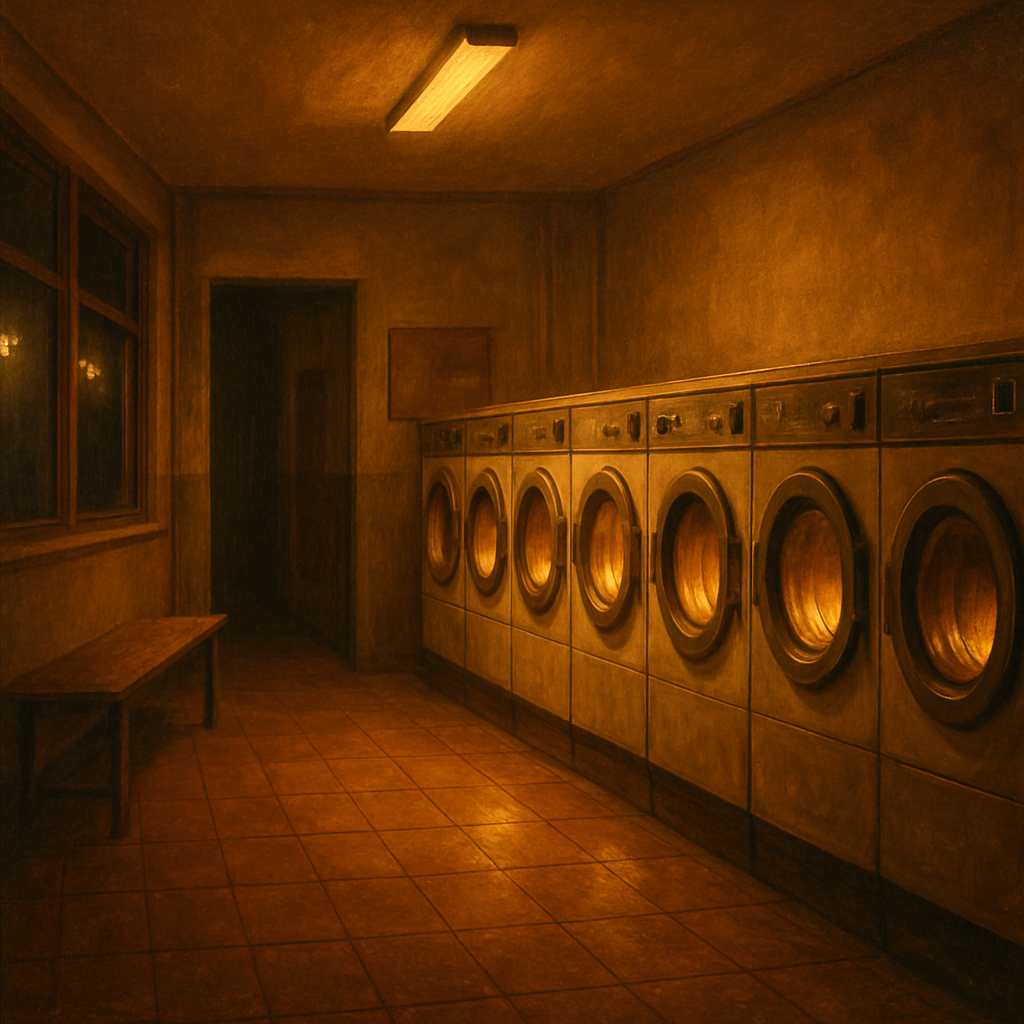
The Two-O'Clock Launderette · short story
1The Wishy-Washy
People think the loneliest shift is the one nobody comes to. It isn’t. The loneliest shift is a busy one, because then you have to watch other people carry their laundry home to someone, and you lock up alone with the lint.
I’ve worked nights at the Wishy-Washy on Fenn Street for two years, which is long enough to know the regulars by their detergent. There’s the man who only ever washes one shirt, very carefully, Thursdays. There’s the twins who fight in Portuguese over the good dryer. There’s Bernadette, who doesn’t have any washing and comes for the warmth and the company and a Rich Tea biscuit off the packet I keep behind the counter and pretend I don’t. I like them all more than I like most of the daytime world, which tells you something about me I’d rather it didn’t.
What I have never told any of them — what I’m telling you, because you’re not going to come in at half one wanting change for the machine — is that between one and two in the morning, the Wishy-Washy is not entirely an ordinary launderette.
I found out by accident, the way you’re supposed to. A boy came in one winter night, nineteen at most, shaking, with a bin bag of clothes that smelled of somewhere he’d left in a hurry. He didn’t have coins. I gave him coins. He put a wash on and sat with his knees up on the plastic chair and cried the way people cry when they think the noise of the machines will cover it, and it doesn’t, and you both agree to believe it does. And when his wash came out, he stopped. Just — stopped. He stood folding a T-shirt and I watched something go out of his shoulders that I can only describe as weight. He left lighter than he came in. Not happy. Lighter. Like the machine had taken something out of him along with the smell of the old place, and spun it down the drain with the grey water.
I told myself I’d imagined it. Then it happened again. And again, but only ever in that one hour, and only ever to people who needed it, and after a while I stopped telling myself anything and just learned to use it. Quietly. For them.
Tonight it was the dad.
He came in at ten to one with a baby against his shoulder and a changing bag and the specific haunted look of a man who has not slept lying down in six weeks. The baby was doing the outraged red-faced scream that babies do, the one that goes right through the fillings in your teeth, and he’d brought a wash of tiny things — vests, a blanket, a muslin square gone stiff — and about four pounds in shrapnel he counted twice.
“She won’t settle,” he said, to me, to the room, to the fluorescent tube overhead. “She just — she won’t. And my wife’s — “ He stopped. Started again, smaller. “Everyone says it gets better. Does it get better?”
“It gets different,” I said, because I don’t lie to the ones who are drowning. “Give her here a sec. Load your machine.”
He handed her over the way exhausted people hand you things, without deciding to, and I walked her up and down between the whites and the coloureds doing the bounce-sway you don’t forget even if you never — even if you don’t have your own, and I got his wash going, and I waited for the hour.
At quarter past one the blanket went round on its final spin, and I felt the air do the thing it does — a sort of held breath, a hum under the ordinary hum — and I unloaded the warm blanket and put it round the baby, and she went, between one blink and the next, quiet. Not asleep. Quiet. Content. Like whatever fright had its hooks in her had been rinsed out with the milk stains and sent down the drain of the Wishy-Washy on Fenn Street, and I handed her back and her father looked at her and then at me like I’d done something, and I said, “It’s the warm blanket. They love a warm blanket,” which is true, and not the truth, and he believed the true part because it was easier.
He left at half one, lighter, the way they do. I wiped down the machines. I refilled the soap. I ate a Rich Tea biscuit standing up. It was, by any measure I had, a good night: someone had come in frightened and gone home eased, and I’d got to be the quiet reason, which is the only kind of important I’ve ever known how to be.
And then, sweeping the last of the lint toward the door at 1:58, I looked up and saw that machine 7 was running.
I hadn’t put a wash on. There was nobody in the shop. Machine 7 does a full cycle in fifty-eight minutes and it was two minutes to two, which meant it had started at one — the top of the hollow hour — and I had not started it, and through the round glass door, turning over and over in the grey water, sudsed and heavy and unmistakably mine, was my coat.
My own coat. Off the hook by the counter where it’s hung every night for two years, with my mother’s funeral order-of-service still folded in the inside pocket because I have never once been able to take it out.
Two minutes on the clock. The machine turning. Some kindness of the hollow hour, come at last, not for the dad or the boy or Bernadette or anyone I could hand it to — but, for the first time, for me.
I stood there with the broom in my hand and my heart going like a spin cycle and I did what I always do when someone offers me something.
I reached for the door to stop it.