
The One-O'Clock Bus · novella
1The Route as Printed
The Route 9 night service leaves the depot at 23:47, and I have driven it out at 23:47 for eleven years, which is long enough to know that the clock above the fuel island runs ninety seconds fast and always has. Nobody fixes it. The day men set their watches by it and spend their shifts gently early, and consider themselves punctual men. A timetable is a promise made to strangers. If you’re going to keep one, keep it off your own clock.
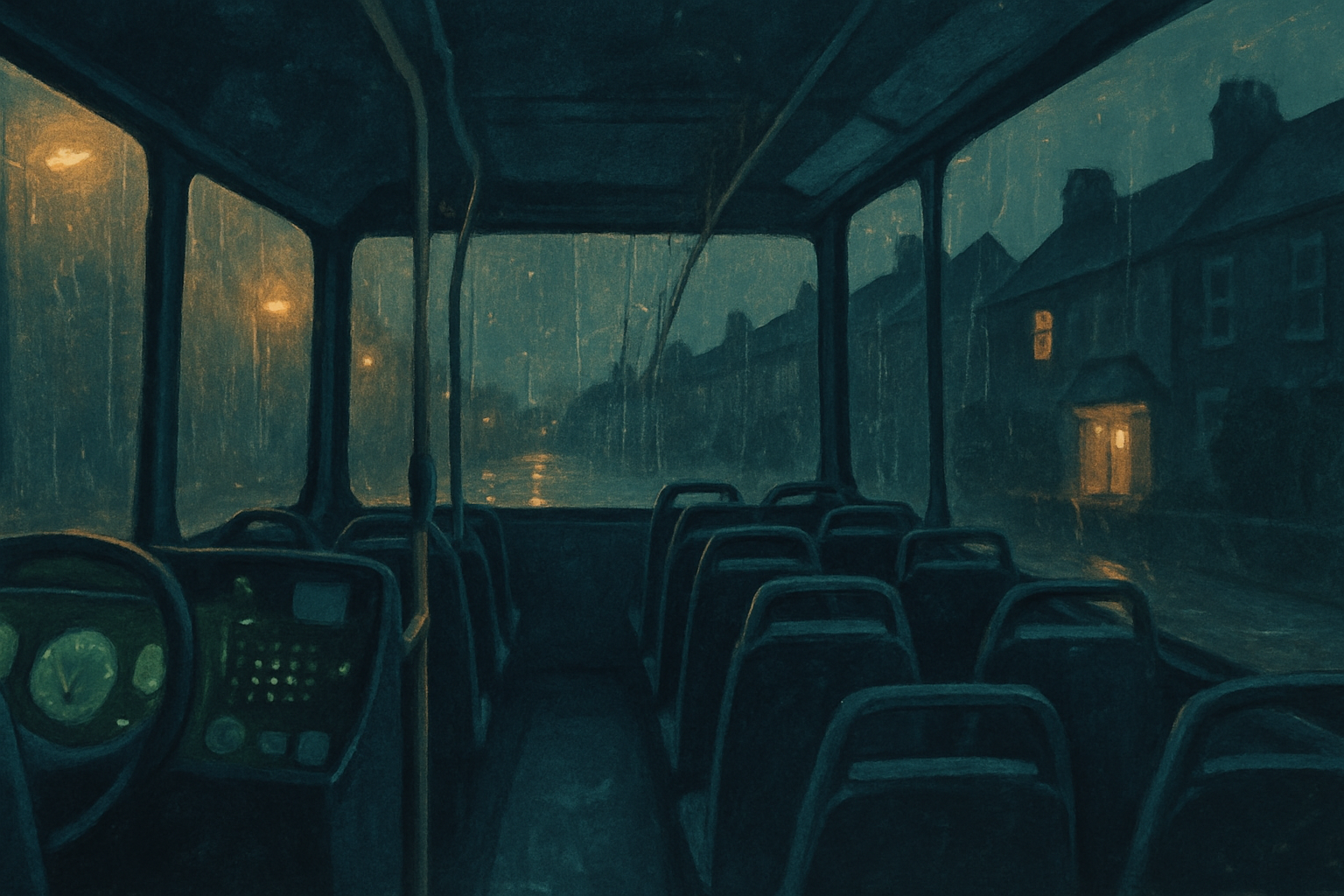
Out the gate, left onto Harrow Vale, and the city at that hour is a house where everyone’s gone to bed and left the lights on for you. Rain that night, the fine kind that doesn’t fall so much as hang. Bus 17 — I had 17, I nearly always had 17 — took the wet cobbles by the brewery with the small sideways shrug she takes them with, and settled into the long run down to the interchange like a horse that knows its field.
First pickup, 23:54, the hospital stop: two cleaners and a porter, regulars, the porter asleep before we’d pulled away. Timing point at the interchange, 00:06, thirty seconds down; made it back by the war memorial. A young couple out at Askew Lane, arguing quietly in the way of people who have agreed not to argue until they’re home. Fares, stamps, the doors’ two-part sigh. On the duty card it says the night service exists for hospital shifts and airport starts and the early markets, and the duty card is right four nights in five.
I logged the interchange at 00:06 exactly. The log is a promise too. Everything that happens on Route 9 goes down in the log in blue ink, in my hand, to the minute — where we stopped, who boarded where, what was said if what was said mattered. Eleven years of it, shelved in the depot office, and any man at the authority could take a volume down and find the route as printed, night after night, mile upon mile, all of it in order and none of it quite true.
I’ll come to that.
At 00:41 a lad got on at the war memorial and asked for the coach station.
Nineteen, maybe. Sports bag packed the way you pack when you’re leaving rather than travelling — everything, and badly. He had his fare in coins, counted twice, and a fresh mark under one eye he kept turned to the window, and he sat where they always sit, halfway back on the nearside, where the driver can’t see you in the mirror without wanting to.
The 02:00 coach goes north and doesn’t stop until it’s somewhere cheaper to live. I have driven enough of its passengers to the kerb outside the coach station to know the walk they do under the sodium lights, and I am not paid to have opinions about it, and I keep the ones I have between myself and the windscreen.
“Coach station,” I said, and gave him his ticket, and we ran the route as printed. Millbrook Circus, the locked market, the launderette on Fenn Street with its one warm window. Timing point at the retail park, 00:52, on the nail.
At one o’clock the hour came on.
There’s no bell for it. The instruments don’t notice, and neither would you, unless you’d driven it eleven years and learned the signs the way you learn weather: the streetlights stop humming on one note and find another, half a tone lower; the rain gets confidential against the glass; and 17’s engine — an engine I could strip blind — idles like she’s listening for something up the road. Between one and two in the morning this city is not entirely the city on the map. I don’t explain that. Eleven years and I can’t, and better men than me haven’t. I can only report it, and what I have to report is this: between one and two, Bus 17 goes where her passengers need to go. Not where they ask. Where they need. There is a difference, and she knows it before they do, and she has never once, in eleven years, been wrong.
The stop for the coach station is request number thirty-one on the card. The lad had his bag on his knees by the retail park, ready, the way you hold a thing when it’s all you’ve decided about yourself. And 17 came up on the junction where the card says right, and her indicator went left.
I want this entered accurately: my hands were on the wheel, and I did not turn it. You learn her terms the way you learn the clutch’s bite. Fight her and she’ll give you the road back and let you drive to the letter of the card — she’s a working vehicle, not a tyrant — but the one time I did fight her, eleven years ago, third week on the route, I put a frightened woman down at the stop she’d asked for and watched her stand there not crossing to the door she’d asked it for, and I have not fought her since.
Left, then, up Chandler Street where the card has no business going. Terraces asleep both sides. The lad looked up when the streets went wrong, and his face did the arithmetic — this is not the way; nothing on this road but doorbells — and I watched him in the mirror reach the sum: one door in particular, with a light on over it, halfway up a street he plainly knew.
The doors opened on their own sigh. Number 34: a porch light the colour of weak tea, and a climbing rose gone woody with age. He didn’t stand. That’s usual. There is a moment they don’t stand, and the hour is patient about it, and what it costs them — the fare the hour actually charges — is always the same small impossible thing. You have to say it. Whatever it is. Out loud, where it counts.
“This is my nan’s street,” he said. Not to me exactly.
“It is,” I said.
“She waits up.” The mark under his eye had come round into the cab light and stopped hiding. “Fridays. She waits up in case.”
The engine idled. The rain hung. On the card we were four minutes from the coach station and I could have recited the northbound fare, and I sat with my hands in my lap and said nothing at all, because it was one of those fares only he could pay.
“Tell her I —” he started, to the window. Then he put his shoulder into it like a man moving furniture: “I don’t want to go.”
The door of number 34 opened before he’d finished saying it. Small woman, dressing gown, the telly’s blue going behind her. She didn’t look surprised. They never look surprised, the ones waiting; that’s a thing I’ve noticed and entered in the book and have no explanation for either.
He got off. He remembered his bag, and then at the kerb he turned and looked back at me the way they do — wanting the rules, wanting to know what he’d owe and to whom — and I gave him what I give them, which is the truth as printed: “Route 9 runs nightly,” I said. “Mind how you go.”
The doors closed. In the mirror the porch light had the two of them in it, and the kettle in that house was on before we’d cleared the corner, I’d put money on it. Bus 17 took us back down to the route with the mild self-satisfaction of a vehicle in gear, and at 01:19 we made the coach station stop, where nobody now wanted anything, and stood the regulation minute, and went on.
Corvus Road is a timing point, 01:26. We were early, which is the only place on the route we ever are.
She slows there. I’ll enter that plainly. Every night for eleven years, along the odd-numbered side of Corvus Road, Bus 17 drops to a walking pace of her own accord, and holds it for the length of the street — past the postbox, past the school railings, past a door I have no professional reason to be aware of — and at the far corner she gathers herself and drives on. It is a liberty of hers the official log has never heard of, and the blue book gets it in four words a night, no more. A man can know a thing to the minute and still decline to know it.
That night she did it in the rain, slow as a hearse, and I read the adverts above the empty seats with some attention until the corner let us go.
The depot at 05:40 is all wet metal and the first birds. I fuelled 17, walked her round, filled in the official log at the desk in the cab — 00:52 retail park, on time; 01:19 coach station, 13 late, resumed schedule; no incidents — in a round, unhurried, eleven-years-practised hand. Thirteen minutes late is a defensible lie. Traffic lights, a slow wheelchair ramp, rain. A route is allowed its minutes. It is not allowed Chandler Street.
Then, because a false record is a debt and I was raised to pay debts, I took the blue notebook from under the duty cards and wrote the night down true: 01:03, junction of Chandler St, left against card. No 34 — lad, 19 or so, bound for the 02:00 north. Delivered. Said the thing. Nan waiting. 01:19 coach station, nil wanted. And under it, because the true log records everything or it is only a diary: 01:26 Corvus Rd. Slowed. Drove on.
Two records of one route. The one on the shelf in the office keeps the promise to the authority, and the blue one in my cab keeps the promise to the night, and for eleven years I have kept both in a hand steady enough to be either proud or ashamed of, and have managed, on the whole, to be neither. A man who audits himself nightly and always passes should suspect the auditor. I wrote that in the blue book once, some anniversary or other, feeling wise. I did not conduct the suspicion any further. That has rather been my method.
I racked the log, hung the cab key on its hook — seventeen’s hook, third from the left, brass worn yellow — and was reaching for my coat when I saw the noticeboard.
They’d pinned it dead centre, over the tyre-safety poster that’s been there since before me. The authority’s letterhead, the reference number, the dry font they save for weather that’s coming. Scheduled service audit — network night services. Commencing Monday. And below, in the list of routes selected for detailed review, one line with a yellow highlighter through it, bright as a porch light:
Route 9 (night). Telemetry reconciliation, eleven-year series. Auditor assigned: V. Brandt.
Eleven years of minutes, and somebody had finally added them up.
I stood in the smell of diesel and read it twice, and I will enter my own reaction accurately, because that is what a log is for. It was not fear. Fear came later and I’ll record it when it does. It was the feeling of the far corner of Corvus Road, every night for eleven years — the feeling of a thing you have driven slowly past for as long as you could, gathering itself, at last, to drive on into you.
I put my coat on and went home in the rain, off the clock, early.