
The Wintering House · novella
1The Arrival
The carriage set me down at the foot of the drive, for the driver would not take his horses further, and I have thought since that this was the first honest thing anyone did for me at Wintering House — though it did not feel like kindness at the time, standing in the wet with my box at my feet and a mile of black gravel ahead, and the house at the end of it watching me come.
It was a tall, plain, grey house, the sort the moor grows rather than the sort that is built, with long windows that gave back no light because there was, in most of them, no light to give. Dusk was coming down off the high ground with the particular haste of that country, where the day does not so much end as withdraw, and the wind came with it through the heather in a sound I would learn to know as the house’s own voice — a low, continuous, sighing complaint that never, in all my time there, entirely ceased.
I had answered the advertisement because I was nine-and-twenty and without means, and because a woman in my position may not be particular about the situations she takes. A companion of good sense and quiet habits is required, it had said, for the mistress of Wintering House, in Blackmoor. Discretion essential. I had read discretion and understood loneliness, and thought I was equal to it, being an expert in that subject if in no other. I had been paid to be pleasant company to other women’s mothers since I was nineteen, and I had learned the whole grammar of the thing: to be present and unpresuming, useful and unseen, family enough to fetch a shawl and never family enough to be remembered in a will. It is a cold trade. I will not pretend I did not hope, walking up that black drive, that Wintering House might at last be different — that I might, here, at the far cold edge of everything, be kept.
The door was opened before I reached it by a woman I took for the housekeeper, a Mrs Hale, grey as the house and about as forthcoming, who looked at me a moment too long before she stood aside.
“You’ll be Miss Thorne,” she said. “You’re expected. Mind you don’t tire her.”
“I should be glad to be presented to Mrs Ravenscar directly,” said I, “that she might tell me her preferences.”
“That won’t be tonight,” said Mrs Hale, and took my wet cloak from my shoulders with hands that were kind though her face was not. “Nor tomorrow, likely. She keeps to herself.” And she said it in a way that closed the subject as firmly as the great door closed the night out behind me.
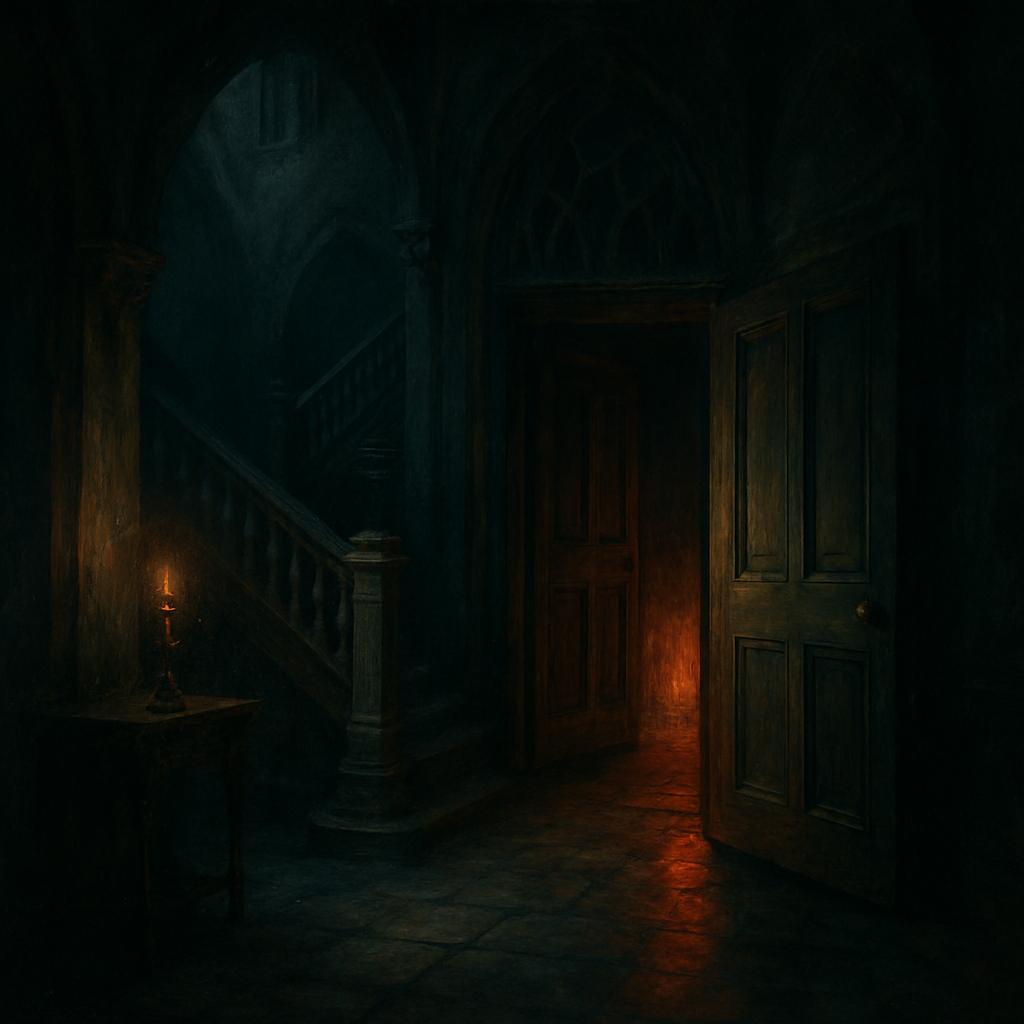
I confess the house within surprised me, for I had prepared myself for cold — a house so situated must be cold — and cold it was, in the hall, in the stair, in the long unlit gallery down which Mrs Hale led me with a single candle that the draughts worried at the whole way. It was a cold that had settled in, a cold of years, the particular chill of rooms kept shut. And so I was the more surprised, passing a door upon the first landing, to feel against my face a breath of warmth — real warmth, the generous warmth of a good fire well built and long tended — issuing from beneath a closed door as we went by, and to see, in the crack of it, the low red light of a hearth.
I paused. I could not help it. After the graveyard chill of that gallery the warmth was so sudden and so human that I turned toward it as a plant turns.
“Not that room, miss,” said Mrs Hale, without turning round, her voice quite even. “That’s the mistress’s room. That’s kept.”
“Kept?” said I.
“Warm,” said Mrs Hale. “Always warm. Come along, you’re this way.” And she went on with the candle, and I had the choice of following the light or being left in the dark of the gallery, and so I followed, as one does; but I looked back once, and the red line of firelight lay along the foot of that closed door like something patient, and I thought — I could not have said why — that the room on the other side of it was not empty, and was not, in any way I understood, waiting for me.
My own room, when we reached it, was small and clean and perfectly cold, with a bed made up and a ewer of water gone chill and a window that gave onto the black moor and the last grey nothing of the light. Mrs Hale set the candle on the washstand.
“Supper’s at eight in the small parlour,” she said. “The family will want to look at you.” She stopped at the door. “You’ll hear things in the night, miss. The wind. Old houses. Take no notice, and you’ll do very well here.” And she looked at me again with that overlong, not-unkind look, as though she were sorry for something that had not yet happened, and then she left me the candle and took the dark away down the gallery with her, past the one warm door, and was gone.
I stood at my cold window with my cold hands folded and looked out at the country that had grown this house, and told myself what a woman in my situation always tells herself: that a post is a post, that I was fortunate, that I should be careful and useful and grateful and ask no questions I was not invited to ask. I told myself I had imagined the wrongness of that warm and firelit room in a house where every other hearth was dead.
But I had not imagined it, and some cold clear part of me — the part I had spent ten years learning to keep folded away beneath my excellent manners — knew already, that first night, that Wintering House kept something warm, and meant, in time, for me to help it.