
The Wind She Would Not Keep · short story
1The Standing Order
They will tell you I am the girl who sold the wind. They are right, though it was a long time ago now, and I have sold a great many winds since, and only the one of them wrong. What follows is the tale of the day I stopped selling them at all. I did it with my own hand, in ink, and thought myself prudent. Keep that word by you. We will want it later, and it will not be worth what I paid for it.
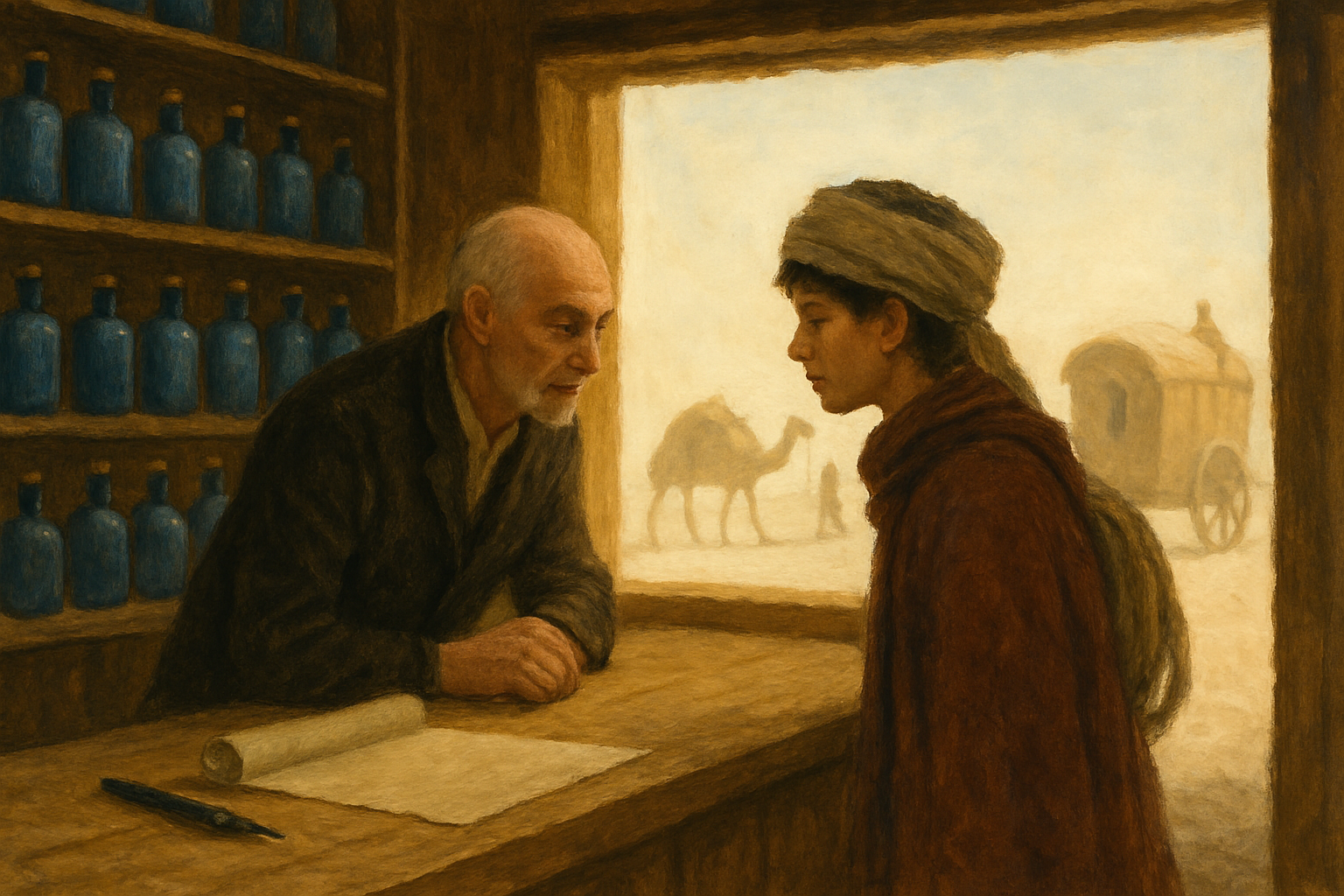
The Ninth Waystation came to me the honest way, which is to say by a death and not a bargain. Old Bostan kept it forty years and had no one to leave it to but a girl who had once done a costly, foolish, right thing at his counter and never quite lived it down. He wrote my name on the deed in a hand gone to spiders and made the caravan-scribe witness it, and then he took his time about dying, the way careful men do, so that by the end I had learned where every bottle stood and why. When he went I hung the striped cloth myself. It is good cloth. Blue and white, faded to the colour of a hot noon, and it snaps in a wind like applause, and under it stand the bottles — every wind of the Bright Waste corked in tall blue glass, the dawn-cool on the low shelf where the tired travellers can reach it, the homesick winds up high where I can keep an eye on who is buying.
I want you to understand what that stall was to me. When I was fourteen I wanted it the way a starving thing wants a table: not the food, the table, the having of it, the never going without again. And now I had it. That is a rarer thing than people say — to get, and go on living afterward with the getting.
What no one tells you is that a thing you have wanted that long does not become yours when you own it. It becomes yours to lose.
I counted the bottles twice a day. I checked the deed was where I had left it, folded in the tea-tin, though nothing on the Road could have moved it but me. And in the worst of the small hours I lay under the cloth and feared the one thing a wind-seller has to fear, which is a season with no wind in it — the sky gone flat and giving, the shelves emptying, no new bottle to replace the sold one, and the striped stall standing over nothing but dust and a deed. I had watched two waystations close that way in my time. It is a quiet ruin. The cloth comes down last.
So you see I was ready for him. He only had to name the fear I was already keeping.
He came on a still day. I noticed the stillness before I noticed the man, the way you notice a debt before you notice who is owed. It was noon and the cloth was not snapping. His caravan stood in the yard — good carts, fat camels, drovers who did not fret — and not one bell on it rang, because there was no air moving through the whole train, as though the wind itself had stepped aside to let it pass.
He was a soft-spoken man, neither old nor young, dressed well and quietly, with the kind of calm that a poorer man mistakes for wisdom and a merchant knows to price higher. He looked at my shelves the way a buyer looks who has already decided, and is only confirming the sum.
“You are Zari,” he said. “Who spent a fortune once to send a wind home.”
“I am the keeper here,” I said, because I have learned that a story told about you at your own counter is usually the opening of a haggle.
“Hadi Sarraf,” he said, “of Sabr.” And he inclined his head, and every drover in the yard went on doing nothing, quietly. “I buy winds. I do not sell them.”
I knew Sabr the way everyone on the Road half-knew it — the still city, the windless dominion, where the richest man in the world had spent thirty years buying up the weather and corking it, so that the sky over his walls hung as flat as a held breath and nothing there ever blew away, or blew in, or was ever taken by the air again. Children were told he kept a storm in a jar. I had thought it a tale. Standing in the dead calm his caravan carried like a smell, I revised the thought.
“A man who buys and never sells,” I said, “is not a merchant. He is a hole in the Road that things fall into.”
He did not take offence. That was the first thing about him that troubled me — I could not find where to push. “You have it exactly,” he said, pleased, as if I had passed a small test. “A hole they fall into and are safe in. Do you know how a wind kills, wind-seller?”
I did. Everyone who sells them does. I said nothing, which he took, correctly, for yes.
“Not by malice.” He said it gently, as one states a settled account. “A wind has no malice. It only does its one true thing, in the one wrong hand, at the one wrong hour.” Something crossed his face then and was gone before I could weigh it — not a grief exactly, but the flat place where a grief has been walked over so many times the ground no longer feels it. “I take them where no hand can reach them. That is all I do. People call it hoarding. I call it mercy, and I sleep.”
Then he made his offer, and it was the most reasonable thing anyone had ever said to me.
He would take my whole stock. Every wind I could catch or buy or coax onto a shelf, he would buy at three times the waystation price, and buy the next, and the next, for as long as I kept the stall — a standing order, he called it, and the words settled over my fear like a lid over a pot. Three times the price. No season of empty shelves, ever, because a bottle sold was a bottle he would pay to replace before the dust found the gap. No sky going flat and taking my table from me. Only one condition, and he set it down as plainly as the coins.
“You sell to me,” he said. “And to no one else.”
I did the arithmetic. It is the thing I am best at, better than winds. Triple price, forever, against the loss of the walk-up trade — the odd traveller with an odd need, a bottle here, a bottle there, coppers against his gold. The sum was not close. The sum was the safest number I had ever been shown.
“Put it in writing,” I said, “or it is only weather.”
He smiled, and I did not like the smile, because it was the smile of a man getting exactly what he came for at exactly the price he meant to pay. He drew the contract from his sleeve already written. Of course he did. He read it to me himself, aloud, every line, in that unraised voice — the price, the terms, the duration — and there was no cheating in it anywhere. I looked for it. Twenty years of a merchant’s suspicion, and I could not find one crooked word. It was the fairest thing I had ever been handed, and I have thought since that this is how the worst bargains come: not crooked, but square. A crooked deal warns you. A fair one flatters you into signing.
He read the last clause last, the way you save the true price for the end.
“And should the keeper sell so much as a single bottle to any hand but Sabr’s,” he read, “the Ninth Waystation, its cloth, its shelves, and its deed, revert entire to the buyer. In full. For that one bottle.”
I remember the sea-wind then. I do not know why my eye went to it — the third bottle on the high shelf, the one that holds a grey salt breath of a coast none of my travellers had ever seen, that I had bought off a dying caravan-master years back and never once had call to sell, so far are we here from any sea. It sat up there catching the noon. I thought: I will never sell that one anyway. I have had it years. Who here wants the sea? And having thought it, I stopped listening to the small thing in me that had gone still and watchful, the way I had stopped listening to the flat cloth an hour before.
“The whole stall,” I said, “for one bottle. That is a hard forfeit.”
“It is a fair one,” he said, and he was right, that was the terrible part, it was — the whole of the condition and the whole of the price laid open in the light. “You need never trigger it. Sell only to me, and it never wakes. I have written it hard so that you will keep it easy.” He set the pen on the counter, turned toward me, level. “You wanted a stall that could not fail, wind-seller. I am the only man alive who can give you one. That is not a boast. It is the offer.”
And there it was, my own oldest wanting, said back to me in a stranger’s fair voice.
I signed.
I will tell you the truth about the signing, because a false ledger is worse than a theft, and this is the book I keep now. It was not that I did not feel the wrongness. I felt it. It stood in me small and cold while my hand moved, the same watchful stillness I had learned as a child to trust and had, somewhere in getting everything I wanted, taught myself to call nerves. I felt it and I overruled it, and I told myself the word for overruling it was prudence, and I watched my own name go onto the fairest contract on the Salt Road in my own steady hand.
He blew on the ink to dry it, gently, which was the only wind I ever saw the man permit.
Then Hadi Sarraf of Sabr rolled the contract into his sleeve, and inclined his head, and his silent caravan took the dead calm away with it out of my yard. By evening the cloth was snapping again. I stood under it among my full blue shelves, every bottle on them promised now to a man who would never open one, and I felt — I will set it down plainly, because it is the whole hinge of the tale — I felt safe. Safer than I had felt since the day the deed came to me. Safe as a held breath.
You know already, I think, the shape of what walks up a road toward a stall like that. It is never the buyer you have provided for. It is the one you have not.
She came three days later, and she had counted her coins so many times across the waste that she knew them by their edges in the dark.