
The Overcount · novella
1The Quittance
A death is the truest number on the ship. Everything else drifts. A harvest comes in fat or thin, a water-claim is guessed at, a birth is a promise the body may not keep. But a death is exact. A death closes a column. When I was small my mother told me the Muster was the one office that never lied, and I believed her, because I had watched her strike a name and I had seen how it steadied her hand rather than shook it. She said: We are not sad here, Wren. We are precise. Precise is a kind of love the sad ones never learn.
I am striking a name now, and my hand is steady, and I am telling myself that.
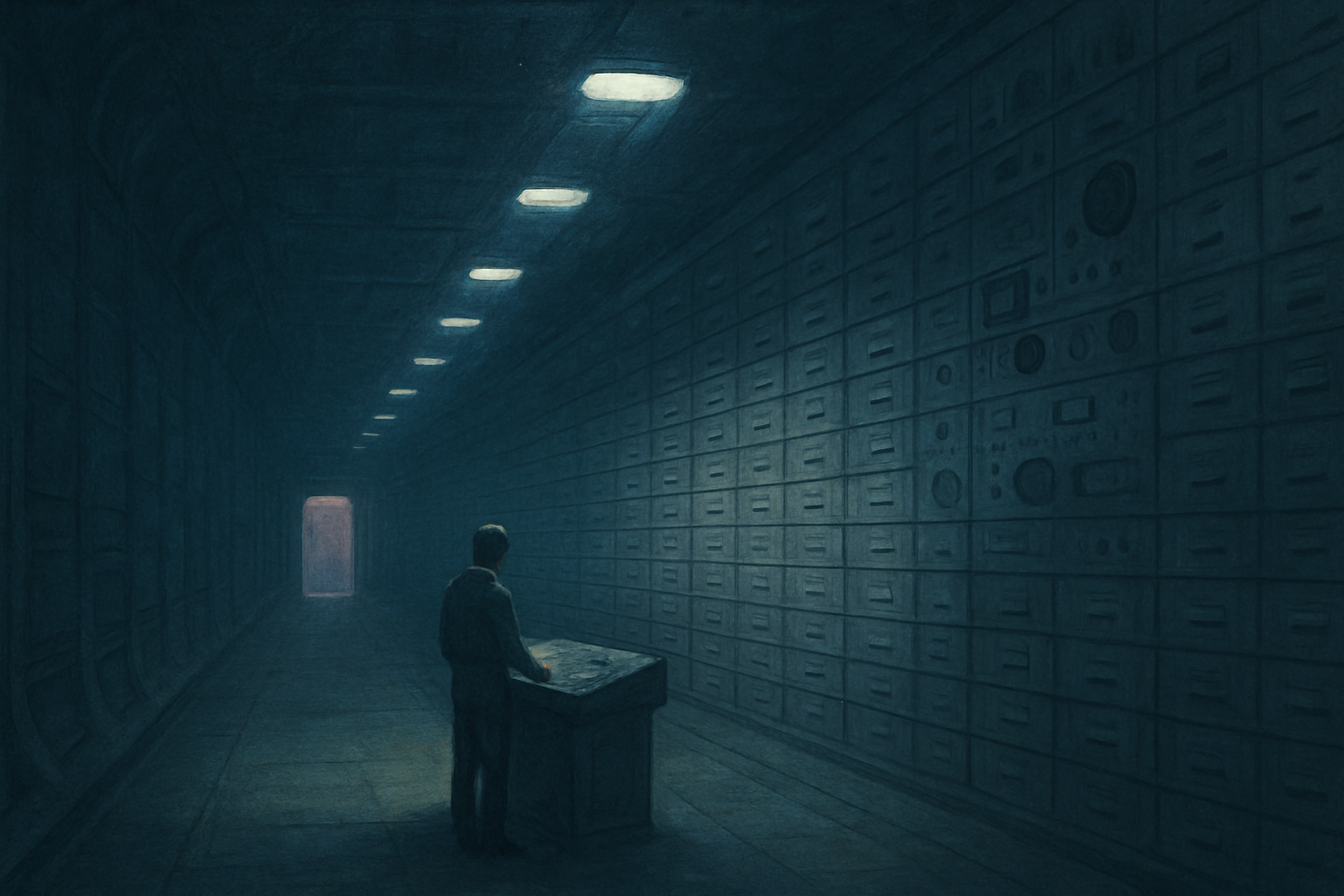
The count-out is held in the muster hall on Deck Nine, under the cold blue of the tally-lamps, and it is the plainest ceremony the ship keeps. No song. The steward of the deck reads the particulars. Two tellers witness. The name goes off the living register and onto the quit-roll, and the share it carried — one body’s ration of air, of water, of grown food, of warmth, the exact wedge of a sealed world that kept it alive — comes free. That is the word we use. Free. As if a death were a door opening rather than closing.
The name today is Sabine Verrine.
I did not ask to witness. I asked. The senior teller, Kestrel, looked at me over her spectacles and said I was too near it, and I said near what, and she let it go, because she is kind and I am not, particularly, and between us that has always been the arrangement. So I am here, striking Sabine, whose hands I have known since I was nine years old and small enough to sit under the grow-lamps in her deck while she pinched suckers off the tomato vines and talked to me as though I were a person and not a child underfoot. She gave me a tomato once, warm off the vine, the first thing I ever ate that no one had rationed to me. I have never told anyone that. It is not on any roll.
The steward reads the particulars. Age fifty-eight. Cause, a failure of the heart, gradual, attended. No dependents on her share. I write it in the fair hand my mother drilled into me, the letters that will still be legible in a hundred years to a teller not yet born, and I strike the name with a single line, because two lines is vanity and no lines is cowardice, and one clean line is the whole of what we owe the dead.
Then Kestrel and I do the reconciliation, and the reconciliation will not close.
You have to understand what the count is for, or you will think we are monsters, and we are not. We are arithmetic.
The Ark Meridian is a sealed thing. Four hundred and eleven years it has carried us, and it will carry our great-grandchildren, and not one atom comes aboard from the black outside or leaves it — every breath any of us takes is a breath the ship makes from what it already has, over and over, the same air, the same water, the same carbon walked from a grave into a garden into a loaf into a child. The founders did the sum before any of us were born. A hull this size, a garden this size, a reclaimer this size, keeps so many alive and steady and no more. Past that number the margins thin. Past that number a bad harvest is not a lean season but a culling. The founders wrote it into the first law of the ship and the Muster has held that number for four centuries, to the body: one aboard for every one the ship can bear, and not one more.
So a birth is never simply allowed. A birth is licensed, and it is licensed against a death — a share must come free before a share can be filled. We call the freed share a quittance. When someone dies, their quittance opens a door for a life waiting to be born, and there is always a life waiting, because we are people and we go on wanting them. It is the hardest mercy the ship keeps and it is a mercy: it is the reason no one on the Meridian has ever starved. My mother struck names for thirty years and never once thought of it as death. She thought of it as making room. A quittance is the ship saying yes the only way a closed world can — by first saying someone has gone.
Sabine’s quittance is a good one. A whole adult share, clean, no dependents. Somewhere on Deck Four a couple I will never meet has been on the birth-list two years, and tonight, because of this, they will be told they may. That is the shape of it. A tomato passed from a dead woman’s hand to a child not yet made. I am not sad here. I am precise.
The reconciliation is the check that the books match the world. It is the dullest hour of my week and I love it the way you love a thing that has never once failed you. We take the living register — every licensed body aboard, to the soul — and we set it against the model: the airkeepers’ measure of what the ship is actually breathing, eating, drinking, warming. The two numbers are the same number. They are always the same number. They have been the same number my whole life and my mother’s whole life, because a sealed world cannot hide a body any more than a sealed jar can hide a fly — a body eats, and a body breathes, and the ship feels the draw of it whether or not the body is on any roll.
I strike Sabine. The living register drops by one. I run the reconciliation to confirm the model has dropped by one to match, the way it has dropped to match every death since the founders, and I wait for the two numbers to lie down together, and they do not.
The model is high. By one.
I run it again. Tellers run things again; it is what we are. The register says the ship carries a certain number of the living, less Sabine now. The model — the honest breath of the ship, the water it actually reclaims, the food that actually goes — says the ship is keeping one more body alive than the register can name.
“Sensor drift,” Kestrel says, not looking up. She has run reconciliations for forty years. “The reclaimer’s been fussy since the Deck Six work. I’ll have Doss recalibrate and we’ll close it in the morning.”
“Yes,” I say.
I do not say the rest, because the rest is not a thought yet, only a cold place opening under one, the way the hull ticks in the dark decks and you tell yourself it is only the cold. I do not say: sensor drift is a hundredth of a body, a rounding, a fly’s weight of error. This is not a hundredth. This is one. One whole share of air and water and warmth, drawn steadily out of a sealed world, night after night, by a mouth the ship can feel and the register has never known.
I have struck a death, and the ship is still breathing for someone I cannot name.
I do not sleep. I go back to the muster hall while the tally-lamps are on their night-dim and I do the thing tellers are trained never to do, which is to stop trusting the number in front of me and start asking how long it has been wrong.
The register is a living book but it keeps its dead, all of them, every quittance since the founders, and the model is logged night on night for four centuries in the airkeepers’ cold archive. If tonight is the first night the two disagree, then it is Sabine, some error tangled in her death, and I will find it and strike it and sleep like my mother slept. That is what I want. I want it badly, and wanting a number to come out a particular way is the beginning of every lie a teller ever told, so I make myself hunt against my own wanting.
It takes until the lamps come back up.
The gap does not start with Sabine. I walk it backward, year by year, my finger down the cold columns, and the model runs high by exactly one for as far as I can carry the reading before the old logs go coarse — years, and years, and more years than I have been alive to witness a reconciliation. One extra breath, held steady in the hull, kept out of every book, since before I was born.
Someone has been aboard my whole life who was never licensed to draw a single mouthful of this air. Not a stowaway of a season — there is nowhere to stow away to, and no ship to have come from; the black outside is four hundred years deep on every side. A person, then. Born here, to the voyage, like all of us — and never entered. Never quit against a death. A share the ship has carried for eighteen years and more, out of margins so quietly thin that no one starved, that no bad harvest tipped, that no teller before me happened to strike a death on the one night the drift stood clear enough to see.
The Muster has one law under all its other laws, the first thing my mother taught me before she taught me the fair hand: the count is the mercy. Every body named, every share accounted, or the whole sealed world tips into a slow famine no one can point to until it is too late to stop. An unlicensed body is not a person to us. It is a leak. It is the ship losing what it cannot make more of. It is the first cold water at the bottom of a hull you had trusted.
That is what I have been taught. I sit under the tally-lamps with eighteen years of a stranger’s stolen breathing laid out in my own fair hand, and I feel the taught thing move in me, the alarm I am supposed to feel, the raise-the-hall, seal-the-decks of it.
And under the taught thing, where I do not look, is a warm tomato passed down from a hand that is now a single clean line in my book, and a small cold question I will spend the rest of this telling trying not to answer, and then answering.
Who has been breathing? And what, precisely, is the Muster for — if not, in the end, for them?