
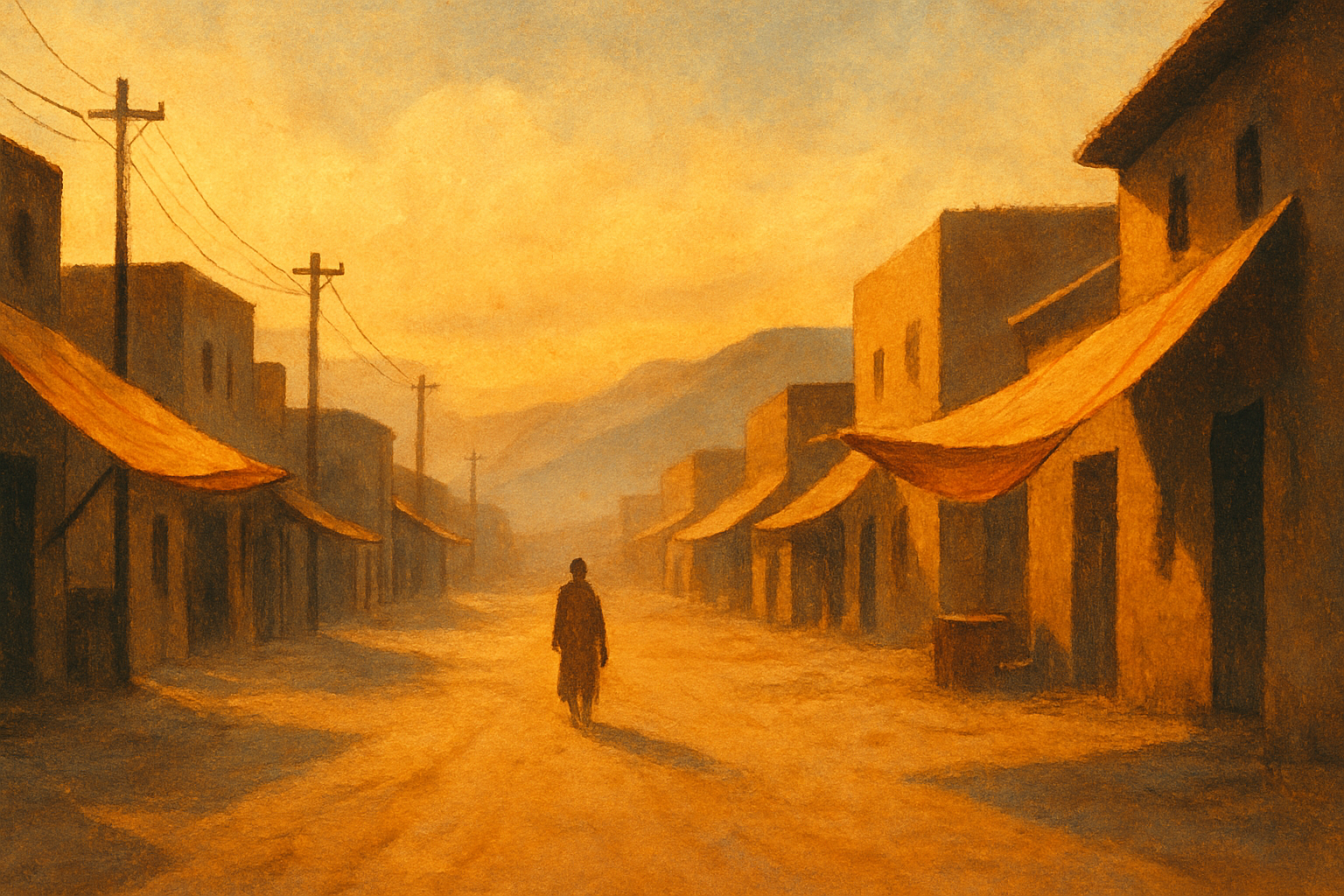
The Hundredth Wind · novelette
1The Ninety-Ninth
Catching a wind is done with the feet, whatever the songs say. Any fool can hold a bottle. You will have seen the pictures — the catcher on the dune-crest at dawn, glass raised to heaven, robes going like banners — and I will tell you for nothing that a man standing like that catches sunstroke and applause and not one thing more. The wind is not up there. The wind is down in the town, worrying the awnings, tasting the bread, reading over everyone’s shoulder. You do not climb to a wind. You walk to where it is going to be, and you are there first, and you make of yourself the most interesting shut thing in the street.
That morning in Zerat I was the most interesting shut thing in three provinces, and I knew it the way a well does: by what kept falling in.
The wind I was after was a small one, as winds go. The chandlers’ quarter had been plagued all spring by a little gusting spirit that snuffed lamps — only lamps, nothing else, the work of a prankster or a moralist, and with winds the two are near neighbours — and the quarter had subscribed together to have it caught, and had paid in advance, which tells you what my name was worth in those days. A crowd had come out to watch. A crowd always came out to watch. Half the craft is the crowd: a wind that has spent all spring being talked about will come and see who is drawing bigger houses, and there is your quarry, sauntering down the chandlers’ row with its hands in its pockets, cool as coin, straight toward an old man sitting alone in the middle of the street beside an open bottle of blue glass.
Sitting, mark you. Not standing on any dune. Sitting on a borrowed stool with my hat off, doing nothing in the most public manner the trade has ever devised.
The lamps along the row went out one by one, little breaths of smoke standing up straight in the dead morning air, and the crowd hushed the way a crowd does when it has been promised a miracle at group rates. The wind came down the street. A wind at close quarters is a texture, not a shape — a busyness, the way the dust will not settle and the flags cannot decide — and this one circled me twice, and snuffed the lamp I had lit for it at my feet, and then put, as it were, its eye to the mouth of the bottle, because a bottle is a shut thing turned inside out: all door. The one thing on the Road a curious wind cannot leave alone.
Forty years of trade in the next part, and it goes in a breath. Lean, speak the name, cork. The name is the whole of it. Glass holds a wind no better than a fishing net would if the name is wrong, and finding a name is a season’s work of listening — what the wind does, what it wants, what it was — done before you ever unpack the glass. This one I had listened to for a month of evenings. A lamp-snuffer. A little sermon of a wind that could not bear a flame left burning past its usefulness. Thrift, I said to it, in the old tongue of the trade, which is nine parts plain speech and one part nerve. Went in like a lamb, I would tell you, except that no wind was ever a lamb; it went in like what it was — a small true thing called by its right name, which cannot help itself any more than you can help turning when they call yours.
The cork went home with a sound like a kiss. The crowd made the sound crowds make. Someone’s baby wailed at the pop of it, and the chandlers began relighting their lamps then and there — which is gratitude for you, buying back the very plague you paid to be rid of, now that it made a better story lit.
Ninety-nine, said the boy who carried my glass for me in Zerat, polishing the bottle before it was an hour caught. Ninety-nine, said the chandlers’ guild-master, over a lunch I did not pay for. The number went up the street ahead of me all that day, and I walked behind it as a man walks behind a good horse, letting it pull.
You will want to know if I felt anything, corking the ninety-ninth. Catchers are asked this the way soldiers are asked, and lie the way soldiers lie. I will tell you what I felt. Under my shirt, in the breast pocket sewn there by someone whose sewing I have outworn everything else of, there is a bottle-stopper of cracked horn, and my hand had gone to it before the cork was home — old habit, older than the fame, a thing the hand does on its own at the moment a catch lands, the way a tongue goes to a broken tooth. Never mind that. I mention it because it belongs to the accounting, and this is a tale about accounting, though neither of us knows it yet.
The Emir’s man found me at supper.
He came into the caravanserai the way still air comes into a room, which is to say the lamps noticed before I did, standing all their flames up straight. A grey man, grey-gloved, with the smell of nothing about him — no dust, no camel, no sweat, no road. On the Salt Road we are none of us overburdened with washing, and a man who smells of nothing has come from a place where the air has been made to behave, and there is one such place, and everyone in that room knew its name and found somewhere else to look.
“Basri Yel,” he said. Not a question. He put a paper on the table, weighted it against nothing — there was no wind in that room to weight it against; the room was holding its breath — and stood back with his hands folded, and let the letterhead introduce him.
The House of Still Air. You will have heard of it, and what you have heard is short of it. A rich man in the west — the Emir Duqal, though the Road says the Still Emir, and says it quietly — has built a house where no air moves. Walls within walls, they say; courts roofed in glass; doors that open one at a time, like a lock being picked slowly. It’s said a candle in the deepest court burns from lighting to guttering without once leaning. And at the heart of it, a vault. Every catcher on the Road knows what is in that vault, and I better than any, because the collection is mine. Bought fairly, bottle by bottle, over thirty years and through forty brokers — my whole life’s take, the dawn winds and the grief winds and the little heresies like this morning’s lamp-snuffer, all of it gone west into the quiet, wind by wind, for prices no honest man could refuse and no curious man could trace. A legend under glass, in a house where nothing knocks but the exhibits.
The paper said the Emir wished to complete the collection.
The paper said the hundredth, and did not need to say which. There is only one wind on the Salt Road that has never been in glass. Towns curse it as the Liar’s Wind, though it never told a lie in its life; what it does is worse, and the curse is honest fear wearing a rude name. It opens shut things. Doors. Shutters. Letters. Ledgers, coats, cellars, mouths. It runs a circuit like a comet, and the towns in its road nail their lives down and stand in the square holding their coat-fronts, and it comes through anyway, laughing — winds do laugh; it is a sound you feel in your teeth — and by evening everyone knows what everyone paid, and who wrote to whom, and what is buried in the third field past the well. No catcher has ever taken it. Catchers do not, as a rule, try. To bottle a wind you must speak its true name into the glass, and the Unbottled has no name you can learn by listening — for it answers, the old ones say, only to a name that is different in every mouth: the thing you will not say. Cheap to speak of, the way curses are cheap. Expensive to stand in front of.
For the hundredth catch, the paper named a fee that was not a fee but an estate. And then, in a clerk’s hand so tidy it read like a held breath, the clause the whole letter had been built to carry: should the offer be declined, the House of Still Air would consider its collection complete as it stands — and would seal the vault.
Understand what he was buying, because I understood it at that table and I want it on the record that I understood. Ninety-nine winds, sealed in the quiet forever, is ninety-nine stories with the doors shut on them. No proving-days. No progresses. No bottles lent to festivals to be marvelled at behind ropes, no guild-hall lectures, no small boys pressing their ears to the glass to hear the dawn wind turn over in its sleep. A collection sealed is a collection forgotten, and the name on every label in that vault is mine. He was not threatening my winds. Nothing so crude. He was threatening my telling — offering to let the whole shelf of me go quiet, the way his house is quiet — unless I came and put on the top of it the one catch that would keep the name Basri Yel in the mouths of the Road for a hundred years.
I have made colder decisions warmer ways. By the bottom of the page I had already gone, and the rest of me signing was formality.
“The Emir sends an instrument,” the grey man said, while I signed, “to verify the catch.” And to the door of the caravanserai, from the dark where she had been standing the whole time — a grey man does not travel with luggage he can’t account for — came a child.
Small, spare, eleven or thereabouts, in good grey cloth cut like a uniform for a rank no army has. She stood in the doorway a moment. Doorways on the Road are where the draughts live; every child alive leans into one to feel the air come through. This one held the frame with both hands and stood the way you stand at the rail of a boat — braced, up on her toes, as if the little travelling breath of the doorway were a sea that might take her — and I thought, there is a child who has never once been out in weather, and I was right, and being right about her was the last comfortable thing that happened to me for some while.
“Noor,” said the grey man, “of the House. She has the ear.”
I did not know, then, what the ear was. I knew what it was worth by the way he said it: the way a man mentions the one tool in the box that cannot be bought twice.
In the morning we went east, the child and I — east, where the Liar’s Wind was running its spring circuit through towns that were already nailing down their lives. A wind that cannot be caught, a child who had never met one, and an old man with ninety-nine stories and his hand on a cracked stopper, going to learn the hundredth’s name.
The whole Road will tell you how the catch of the age was made. The Road has it wrong, root and flower, and the Road may keep it wrong for all of me — but you paid for a tale, and a tale is a bargain, and on the Salt Road a bargain keeps to the letter. Here is the letter of it. It begins with a lamp-snuffer and a grey man; it ends in the quietest house in the world, with every door in it open at once.