
The Cinderwick Job · novelette
1The Whistle
There are three ways out of any room in Cinderwick, and the trick to my line of work is knowing all three before you know why you’ll need them. The countinghouse on Vane Street had a door, a window over a thirty-foot drop, and a coal chute nobody had used since the fog got into the flues. I had already decided on the coal chute when the clerk looked up from his ledger and saw me standing where a person very much should not have been.
“Evening,” I said, because good manners cost nothing and buy you half a second, which is sometimes the whole game.
The thing I had come for was in my coat by then — a snuffbox, brass, dented, worth about as much as the coal chute unless you knew what I knew, which was that on the night of a new moon it would hold its breath and keep whatever you whispered into it fresh for a year. A curio. A small one. The Reach is full of small ones: a spoon that stirs sugar the way your mother did, a bootlace that never comes untied, a thousand little marvels that do one modest impossible thing and then, disappointingly, nothing else. Most aren’t worth stealing. This one had a buyer in the Saltmarket who’d pay enough to keep me in coal and trouble for a month, and a month is as far ahead as I like to plan.
The clerk did the thing clerks do, which is reach for the bell-pull instead of the window. I want to be clear that I don’t blame him. A braver man would have gone for the window and had a chance. He rang, and three streets of Cinderwick woke up at once, and I went down the coal chute.
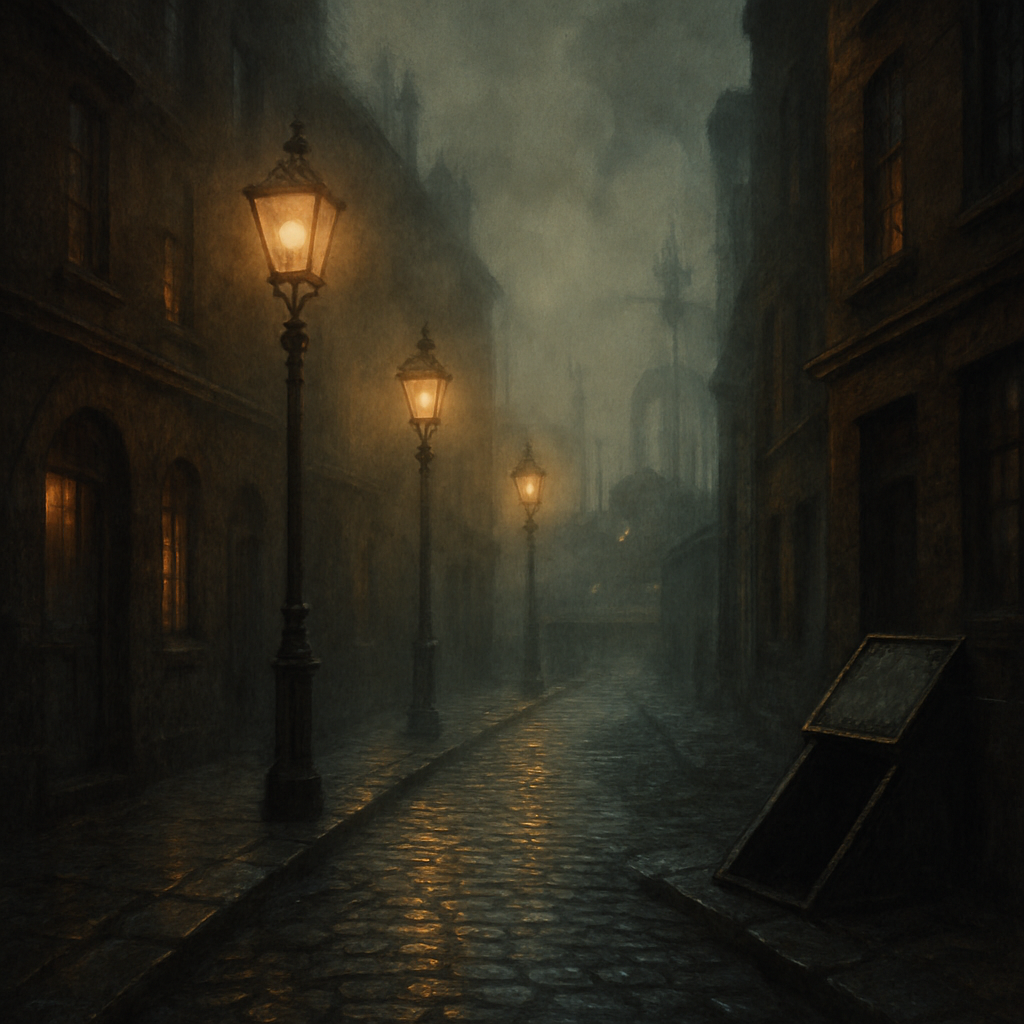
I should tell you about the Understair, since it’s about to save my life and will again before this is over. Cinderwick is built up a hill so steep that half the city is stairs, and under the stairs — under all of it — runs a second city: service tunnels, dead funicular runs, tube-lines the postal company forgot, cellars that opened into cellars until somebody bricked the wrong one and made a mile of dark. Nobody owns the Understair. The Ordinal would like to. For now it belongs to whoever knows it, and I know it the way you know the inside of your own mouth — without looking, in the dark, by feel.
I came out of the chute into a coal cellar, out of the cellar into a tube-run, and by the time the watch-whistles started up on Vane Street I was two levels down and one hill over, walking not running, because running is for people who don’t know where they are. My heart was doing the good thing it does after a job, the bright hammering that is the closest I come to happy. I’d been doing this eleven years. It had never once stopped being the best feeling I own.
Which is exactly when I noticed I was being followed, and the feeling curdled.
You learn footsteps in the Understair. The dark strips a person down to their walk, and this walk was wrong — too even, too patient, matching my pace when I slowed and again when I quickened, the walk of someone who is not trying to catch you because they already know where you’re going. I stopped under a gas-flare at the Threadneedle junction, where five tunnels meet and the light is just enough to see a face. I turned around with my hand on the little curved knife I carry for exactly this and absolutely no one was there.
That should have been a relief. It wasn’t. Because on the ledge beside the flare, weighted down with a river-stone so the draft wouldn’t take it, was a calling card. Cream paper. Expensive. Face up, as though it had been set out for me and only me, in a tunnel I had chosen at random three seconds before I chose it.
I don’t spook. It’s a professional requirement. I picked up the card.
There was no name on it, no address, no crest — the Ordinal loves a crest and this had none, which frightened me more than a crest would have. Just one line, in a small, careful hand, in ink still tacky enough to smudge under my thumb.
It said: Good evening, Junia Wren.
I stood very still in the light of the flare with the whistles fading three levels up and the snuffbox breathing its patient nothing against my ribs, and I read it again, because the first time I was sure I’d read it wrong.
Nobody in Cinderwick knows that name. Nobody in the Reach knows that name. Juno Vale has been Juno Vale for eleven years, since the night a person I trusted with everything sold Junia Wren to the Ordinal for the price of a night-mail ticket out, and I put that girl in the river along with the man who named her and walked into the city as somebody new. I have been very, very careful. Careful is the only thing I’ve ever been better at than stealing.
And somebody had just set that name in front of me, in the dark, underground, in ink that was still wet.
The professional move — the only sane move — is to burn the card, go to ground, and be three cities away by morning, no job, no buyer, no explanations owed to anyone. I have done it before. I know exactly how. I stood there with the flame right beside me, close enough to do it, and I did not do it, because down at the bottom of the card, smaller still, the careful hand had added a second line, and the second line was the worst thing anyone has ever written to me.
It said: A door only you can open. Ask at the Cage.
The Cage is the Ordinal’s auction house. It is the single most locked, watched, and lethal building on the hill, and asking at the Cage is the sort of thing a person does once, on their way to not being a person anymore.
I have a flaw. I know I have it; knowing hasn’t ever helped. I cannot walk away from a door somebody tells me I can’t open. It is why I’m the best finder in Cinderwick and it is going to be, one of these days, precisely how I die — and standing at the Threadneedle junction with my buried name going tacky under my thumb, I felt the flaw wake up and stretch and grin, and I knew, the way you know weather, that I was going to ask at the Cage.
I put the card in my pocket, next to the snuffbox that keeps secrets for a year, and I went to sell a curio to a man in the Saltmarket, and the whole way up through the dark I was already, God help me, planning the job.