
The Cartographer of Decks · novelette
1The Discrepancy
A corridor is honest. This is the first thing they teach you in the Office, and the truest. People lie, records rot, the Purpose is a story we agree to tell — but a corridor is a length of hull with two ends, and if you walk it heel-to-toe and count your steps, it will tell you exactly what it is and nothing else. I have loved this about my work since I was nine years old and my grandmother let me hold the stylus. In a ship of eleven thousand souls all carrying one another’s moods around like weather, the corridors were the only things that never disappointed me.
I should have known better than to say so out loud.
My survey that watch was Deck Fourteen, aft-spinward, a maintenance run nobody had walked with a stylus in thirty years because nothing down there ever changes. That is the point of a resurvey: you prove the ship is still the ship. You confirm the charts. You go home. I like the ones nobody else wants; you get the quiet, and the quiet is where I do my best counting.
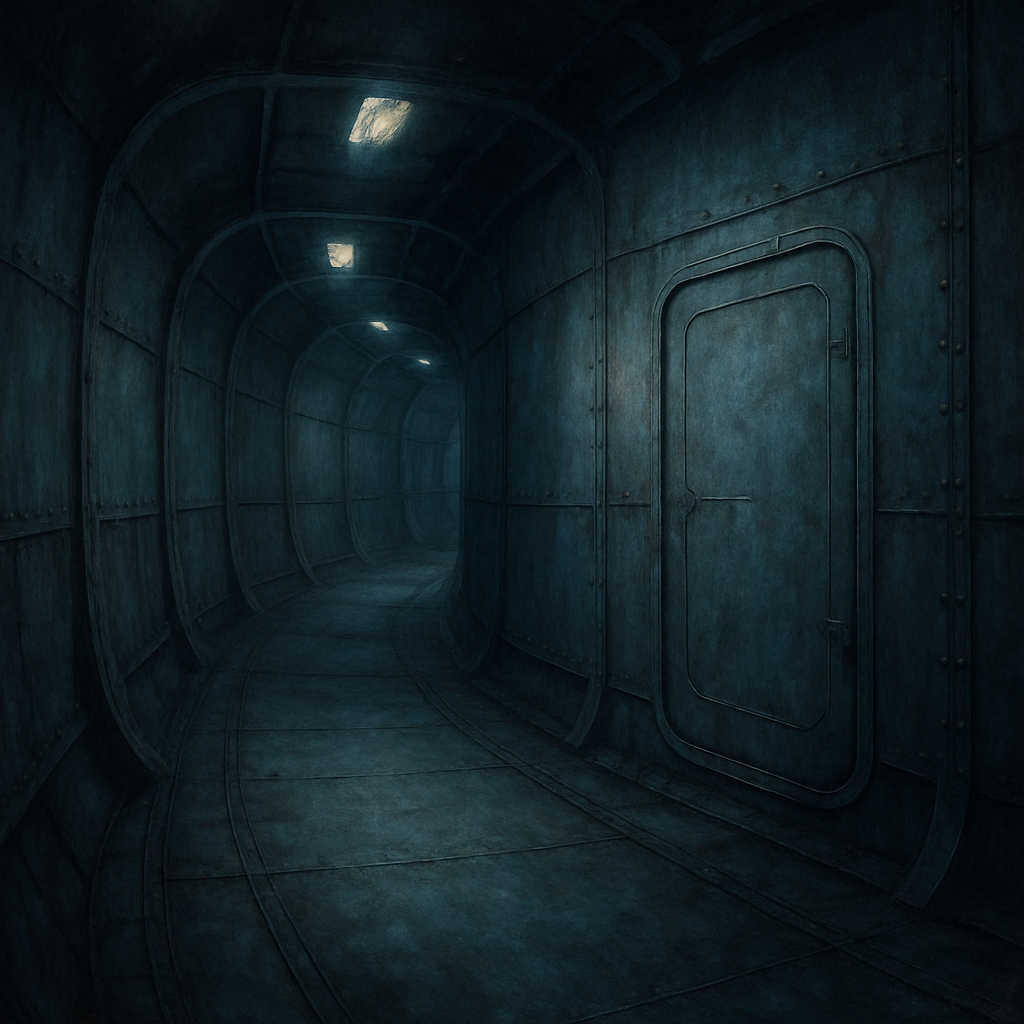
Fourteen-aft is a single corridor, curved with the spin, running from the coolant gate at frame 90 to a sealed bulkhead at frame 118. Twenty-eight frames. The master chart gives it as one hundred and sixty-one metres, and the master chart has given it as one hundred and sixty-one metres for four hundred years, in my grandmother’s hand and her predecessor’s before her, back to the founders who drew the first true map of the world they built.
I walked it heel-to-toe, counting, the way you’re taught, the way I have counted ten thousand corridors. And at frame 118, with my back to the sealed bulkhead and the cold of the outer decks soaking through my soles, my count came to one hundred and sixty-nine.
Eight metres.
I want to explain how small that is and how impossible. Eight metres is nothing — the length of the survey sled, a held breath, a mistake any tired junior might make. And I am not a tired junior. I have never miscounted a corridor in my life, and even if I had, the error would be mine, a wrong number in my head; it would not be there, in the hull, eight metres of corridor that the founders’ map insists does not exist.
I did what you are trained to do with a discrepancy. I assumed I was wrong. I walked it again. One hundred and sixty-nine. I laid the laser to it, which removes the human entirely, and the laser returned one hundred and sixty-nine point one one, and lasers do not get tired or want anything or hope. I sat down on the cold deck with my back against a bulkhead that the chart called the end of the corridor, and I put my hand flat on it, and I understood two things at once, the way you sometimes understand things all in a rush after understanding nothing for years.
The first was that the bulkhead was not the end of the corridor. It was a wall built in the corridor, eight metres short of the true hull, and built well, and built long ago, and the map had been drawn to it on purpose so that no one counting would ever count past it — no one except a person foolish enough to distrust the map more than her own two feet.
The second was that behind it, in the eight metres the founders had erased from the world, there was a hatch. I could feel the seam of it under my palm, cold and exact, a rectangle where the plating should have been continuous. A hatch into a deck that appears on no chart, in a ship where every corridor has been counted and loved and recorded for four hundred years by people who told their children that the map was complete, that the world was known, that we carry it forward toward a morning none of us will see.
I sat there a long time with my hand on the seam. Down the corridor the coolant gate ticked and sighed. Somewhere above me eleven thousand people slept inside a story, and I was the cartographer, the one whose whole small honest life was built on the promise that the map and the world were the same thing.
I took out my stylus. My hand was not quite steady, which it had never once been before over a survey. And instead of writing 161 m, confirmed, the way four hundred years of my office had written it, I wrote down the true number, and then I drew, very carefully, the seam of a door that was not supposed to be there.