
The Blindfold Act · novelette
1The Pay-Wagon
Here is the trick, since you paid your dime and it is the only honest thing I will sell you tonight: I read you before you sit down. The dust on the left knee of your trousers and not the right — you knelt to something, a grave or a keyhole, I’ll know which by your mouth. The pale band on a brown finger where a ring used to be. The way you hold your hat like it might be taken. By the time you are across my little table and I have tied the spangled blindfold over my eyes and told the tip I see all, I have already seen all, and none of it by magic. There is no magic. There is only a woman who has spent fifteen years looking so hard at strangers that she has clean forgotten how it feels to be looked at back.
That is the act. Madame Sonora, who sees. They love her, the towns. They never once wonder why a woman who can read the whole aching inside of a stranger keeps a cloth tied over her eyes to do it. Blind, and seeing everything. If you want to know a person’s secret, watch what they do in plain sight and call it mystery.
We were three nights into nowhere — a mud lot outside a town whose name I never learned and will not invent for you, wheat to the flat horizon and a water tower with the paint gone — with the Aurelio Bros. carnival strung out across it like wash on a line. There were never any brothers. There was Gus Aurelio, who called himself Colonel and owned the canvas, the wagons, the contracts, and the last word on all of it, and who had built this crooked family one runaway at a time and believed, the way a man believes his own hands, that a father is owed. We were his. That is the first commandment of the life, the one you learn before your own act: with it and for it. You cover your own. You keep the gaff. You take the road over the badge every time, because the road is the only thing that has never yet turned you in.
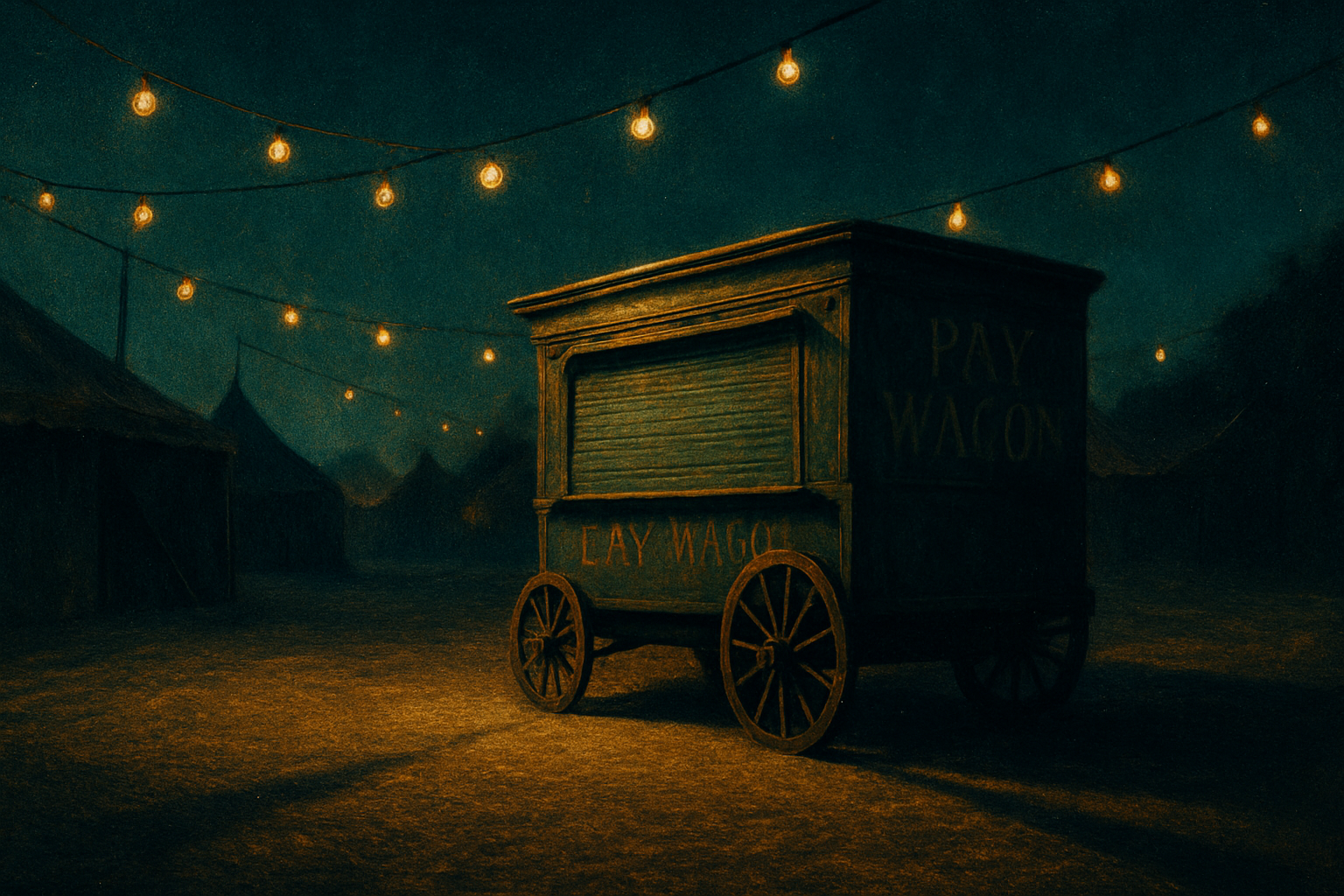
We would have taken it that Friday, same as always, dimes in the box and the town in the mirror. Except that on the third morning the Colonel did not come out of his pay-wagon to count us, and the pay-wagon was locked from the inside of the padlock’s habit and would not open, and when Sallow the cook finally put a boot through the little side window and climbed in, he came back out the color of the canvas and sat down in the mud like his strings were cut.
I got there before the sheriff, which matters, so remember it.
The pay-wagon is the heart of a show and its safe both — the one wagon where the week’s take sleeps, a green iron box bolted to the floor and a cot beside it where the Colonel slept on top of his money like a dragon on a hoard. He was on the floor between the cot and the cold stove, and he had been for some hours; I will spare you what a night does, because I looked once and then made myself do the other thing, the working thing, the only thing I have ever been any good at. I read the room.
The iron box stood open and empty. The whole week’s take — three towns’ worth, the Colonel’s dragon-hoard — gone to the last coin. So: robbery, the sheriff would say, and he would not be entirely wrong, and that was the trouble already, because a robbery wants a robber and a strange town wants him to be one of us.
But the padlock. I want you to see the padlock, because I did, and did not yet understand that I was seeing the whole story hasped shut in a half-inch of brass. It hung on the outside staple, snapped closed. A wagon locked from the outside, with the owner cold inside it and the window whole until Sallow’s boot. And it was fixed with the spare-hasp turn — the little cheat where you loop the shackle twice so a worn lock catches — which the Colonel never used in his life, because it was his lock and he trusted it, and which I knew on sight the way you know your own handwriting in a stranger’s letter, because it is a thing I teach. It is a small thing I teach a girl her first week, so she can lock a trunk that has no key. I filed it where I file things and did not look at it again, and if you think that was innocence you have not been listening: I filed it because some cold clerk at the back of me had already read it and did not want the rest of me to.
They were all outside by then, the family, in the gray before the town woke — the ride-jocks and the cook-house crew and the ten-in-one in various states of undress and disbelief. Bruno stood at the front of it with his big hands hanging useless, our strongman, who lifts a hollow dumbbell for the rubes and could not lift the look off his own face; he had loved the old man in the plain, exasperated way you love a landlord you also need. The fortune-teller kept crossing herself, which she does for weather. And at the back, half a step outside the huddle where she always stands, was Lark.
You do not know Lark yet. You will. She is sixteen, or says so, and she came to us a year ago off some road with a bruise she wouldn’t name, and I took her in and started teaching her the trade — the hands, the hook, the wall you build so high that no townie and no man ever climbs it again. I taught her well. I taught her, I would learn, further than I meant. That morning she was the only one of us not making a sound, standing very still with her face arranged into exactly the right grief, and I registered the arrangement of it the way I register a mark’s tell and then, God help me, looked away, because I was her teacher and the arrangement was mine. A wall I had built, built well. You are proud, at first, of the walls you build in other people. It is the last thing you learn to be afraid of.
The sheriff came at full morning with the town behind his eyes.
He was a tired man in a hat that had cost him a week’s pay once and never would again, and he did his reading the same as I do mine, only cruder and out loud. He read the canvas and the wheels and the shed names, and he read drifter and grifter and good riddance, and I watched him decide the shape of it before he’d crossed the lot: a carnival, a corpse, a robbery, and a whole town that would sleep easier once the whole rotten circus was somebody else’s county. He did not need it to be true. He needed it to be gone by Friday, and a body doesn’t go by Friday unless it’s got a name pinned to it first.
His eyes went to Bruno the way water goes downhill. Big outside man, big hands, no town would ever miss him. It is the oldest reading in the world and it is nearly always wrong, and I have made my whole living on how nearly-always people prefer the easy face to the true one.
Our patch was already moving — the fixer, the man who squares the local law with cash and a smile every stop we make — sliding up on the sheriff’s blind side with his voice going warm. And I heard the machine of us start up, the old machine, the with-it-and-for-it of it: bury it, square it, close the wagon, grease the badge, and roll. Friday. The road has never turned us in. Let the town have its drifter and let us have the horizon, and don’t any of you look too long at a padlock.
I stood in the churned mud with a dead father in a locked box behind me and my whole crooked family around me arranging their faces, and I did the arithmetic I am cursed to do. The sheriff would take the easy face. The show would let him, or feed him one, so long as it wasn’t ours — and Bruno, who is barely ours, who is hired muscle from Toledo with no wall and no gaff and no road to run to, was the easiest face on the lot. He would do fine. He would do nicely. Nobody with it and nobody in the town would lose a night’s sleep, and the box would stay shut, and I would never have to know whose hands had turned that spare-hasp cheat I teach a girl her first week.
It costs nothing, is the thing. That is what I need you to understand before the rest of it, because you are a mark too and I will not lie to you the way I lie to the tips. The comfortable thing cost me absolutely nothing. Let the town hang its stranger, keep the family, keep the act, keep the blindfold on. All I had to do was the one thing I have done beautifully every day of my life, which is not look.
I have never in my life been able to leave a face unread. It is the only honest hunger I have got.
So I did the stupid thing, the expensive thing, the thing that would take the blindfold off me for good and cost me the act and the road and the one person I — but I am ahead of myself, and a reader hates to be rushed to the hurt. I will only tell you what I decided, standing in that mud while the patch bought us Friday and the sheriff sized up a man from Toledo for a rope.
I decided I would read them myself. My own. Every last one of the family, down to the girl standing too still at the back with her grief on straight — read them the way I read the rubes, before the sheriff pinned his easy name on the wrong man and we all rolled off clean into the wheat. Find the truth first, and then decide what to do with it, which is a sentence a smarter woman would have heard the trap in.
I had spent fifteen years being the only one at the carnival nobody could read.
I was about to find out why I’d worked so hard at it.